
Exporting to Japan: Strategic Guide for NZ Businesses
For New Zealand businesses, Japan represents a sophisticated, high-value market as the worlds fourth largest economy. While NZ products enjoy an excellent high quality reputation, many exporters hit a cultural wall that stalls negotiations for reasons completely unrelated to the product itself.
Success in Japan is less about having the best spec sheet and more about how effectively you earn trust currency by respecting Japans unwritten rules. This guide outlines the structural barriers of the Japanese market and the specific cultural nuances required to overcome them.
The Three Primary Barriers to Japan Market Entry
For New Zealand business leaders, the most daunting challenges are often structural and systemic rather than personal.
1. Complex Distribution
- The NZ Norm: Lean supply chains with direct paths from producer to retailer.
- The Japan Reality: A multi-layered ecosystem involving export houses, import agents, and multiple tiers of wholesalers (tonya).
- The Risk: Attempting to bypass these established layers to sell “direct” can often backfire. In Japan, honoring long-standing commercial relationships is a non-negotiable prerequisite for market stability.
2. The Language and Nuance Gap
- The Reality: The true barrier is not merely the language itself, but the high-context nature of Japanese communication—the ability to “read the air” (kuuki wo yomu).
- The Risk: A Japanese partner may state they will “study a proposal positively.” While a New Zealander might interpret this as a green light, it is frequently a polite professional courtesy used to signal a decline without causing a direct confrontation.
3. Cultural Rigor vs. “She’ll be Right”
- The Reality: The relaxed Kiwi “she’ll be right” attitude can be misperceived by Japanese counterparts as a lack of professionalism or inadequate risk management.
- The Risk: Minor oversights—such as sending a junior representative to a meeting when a senior executive’s presence was expected—can be perceived as a slight to the partner’s status, causing a deal to silently dissolve before it even begins.
Etiquette as a Tool for Business Trust in Japan
Business etiquette in Japan is a diagnostic test. It tells the Japanese partner whether you are a reliable professional capable of adapting to their market.
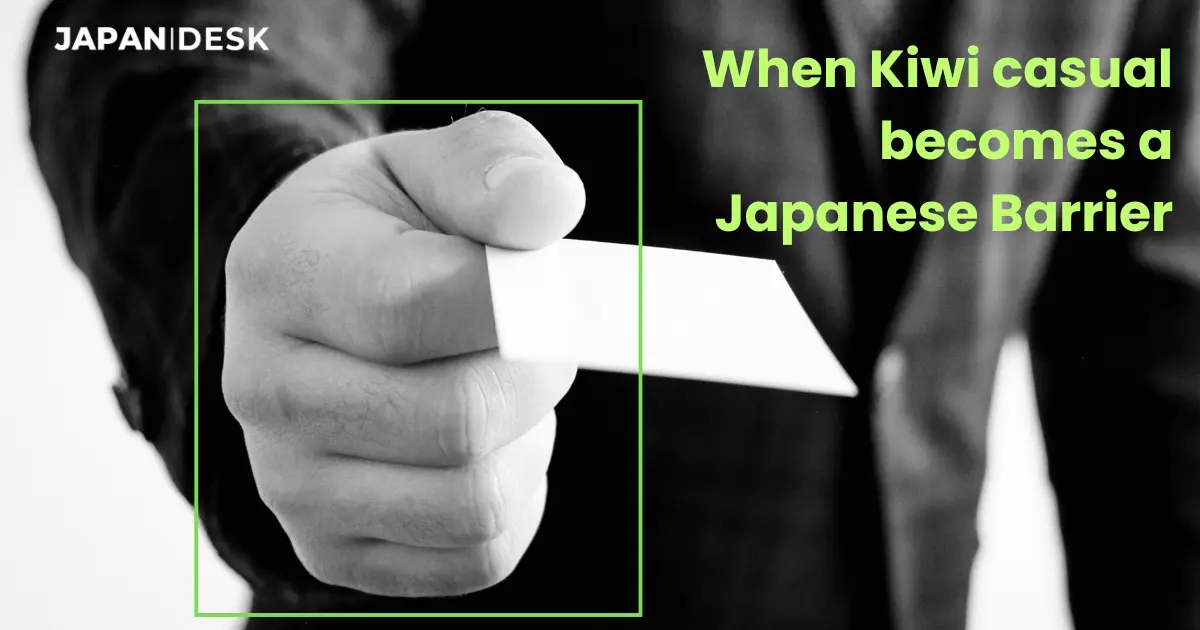
1. Meishi Koukan (Business Card Exchange)
- The Basics: Standing and presenting your card with both hands conveys respect not just for the individual, but for the organization they represent.
- Strategic View: This is a critical intelligence-gathering exercise. It allows you to immediately map the internal hierarchy, identifying the decision-makers who hold the budget versus the managers who drive execution.
2. Sekiji (Seating Order)
- The Basics: A strict seating order (Kamiza/Shimoza) dictates that the most senior person sits furthest from the door.
- Strategic View: Seating arrangements make the power balance visible. Adhering to the correct placement signals that you respect their internal structure and are a “safe” partner who understands the gravity of their organizational order.
3. Ho-Ren-So (Report, Liaison, Consult)
- The Basics: A commitment to frequent communication and transparency throughout every stage of a project.
- Strategic View: By reporting minor progress often and “bad news” early, you provide your Japanese counterparts with the narrative and peace of mind they need to justify the partnership to their own stakeholders.
Mastering Communication: Honne and Tatemae
While Kiwi friendliness is a significant asset, it must be strategically balanced with an understanding of Japan’s conflict-avoidance culture.
1. Icebreaking through Commonality
The Strategy: Resisting the urge to “get down to business” immediately is crucial. Allocate significant time to discovering common ground or highlighting connections to respected mutual acquaintances. In Japan, the strength of the personal foundation determines the height of the business skyscraper.
2. Decoding the “Soft No”
The Reality: Japanese partners rarely issue a direct “no.” Instead, they employ phrases such as “it is difficult” (muzukashii) or “the timing may not be ideal.”
The Risk: If a partner describes a proposal as “interesting” while maintaining a polite smile, there is often a hidden bottleneck. Rather than pushing for a close, pivot to a supportive stance: gently inquire if there are specific internal concerns or “homework” you can assist with to address their underlying hesitation.
3. Leveraging Interpreters as Strategic Advisors
The Strategy: Treat your interpreter as a cultural consultant rather than a mere translation tool.
The Execution: Brief them thoroughly on your strategic goals beforehand. This empowers them to not only translate words but to “read the air,” helping you navigate the underlying vibe of the room and identify the Honne (true intent) that often remains unspoken during formal negotiations.
Relationship Building and Strategic Follow-up
The actions taken immediately following a meeting determine whether a budding connection becomes a solid foundation or remains a one-off encounter.
1. High-Velocity Follow-up
The Strategy: Dispatch a “thank you” email immediately, including a concise recap of actionable next steps.
The Execution: Japanese partners place immense value on intermediate progress reports. Do not wait for a task to be 100% complete before making contact; providing “20% updates” builds a narrative of reliability and transparency.
2. The Evolution of Business Socializing
The Reality: The era of mandatory late-night heavy drinking is fading. Modern Japanese business culture increasingly favors business lunches or professional coffee meetings.
The Advantage: These settings are lower-risk, highly time-efficient, and effective for building rapport within a contemporary corporate environment.
3. Professionalism in Presentation
The Cultural Gap: In New Zealand, senior directors often operate in casual attire. In Japan, your appearance is viewed as a direct measure of your respect for the client.
The Rule: For the initial series of meetings, adhere to a suit or a conservative professional blazer and trousers. Mirroring their level of formality signals that you take the partnership seriously.
Navigating the Japanese Decision-Making Process (Nemawashi)
The Japanese consensus-building model is often the primary source of frustration for New Zealand exporters. Understanding its mechanics is key to maintaining sanity and momentum.
1. The Value of Consensus (Bottom-Up)
The Reality: Unlike the top-down decisiveness common in NZ, Japan prioritizes bottom-up consensus. This ensures that once a decision is made, the entire organization is aligned for execution.
The Strategy: Expect the timeline to be longer than in NZ. Avoid pressuring for a “yes” or “no” before the internal foundation of trust is solidified; premature pressure can often trigger a defensive “no.”
2. The Art of Nemawashi (The Meeting Before the Meeting)
The Concept: In Japan, formal meetings are often for the official announcement of a decision, not the debate. The real work happens during Nemawashi—the informal process of quietly laying the groundwork and securing individual buy-in behind the scenes.
The Strategic View: Successful exporters use their Japanese partners or consultants to identify and influence the “invisible stakeholders” who may never sit at the main negotiation table but hold the power of veto.
Conclusion: The Japan Desk Advantage (NZ-Based Execution)
While Japanese business etiquette may appear rigid, its core is built on deep mutual respect and meticulous risk mitigation. Navigating these nuances is the difference between a stalled negotiation and a generational partnership.
Your New Zealand Partner with Japan Expertise
Because Japan Desk is based right here in New Zealand, we operate in your time zone and speak your business language. We bridge the gap between Kiwi flexibility and Japanese discipline, providing the deep local knowledge required to navigate “the unwritten rules” without the friction of a long-distance relationship.
Hands-on Strategic Execution
We don’t just advise; we execute. From untangling complex distribution layers to bridging the language gap and managing the Nemawashi process, we act as your dedicated, outsourced Japan department.
Positioning for Long-Term Success
In the world’s most rewarding market, reputation is everything. Japan Desk ensures your brand is positioned correctly from day one, turning cultural barriers into your greatest competitive advantage.pline, Japan Desk ensures your brand is positioned for long term success in the worlds most rewarding market.