
What MFAT in Auckland’s Post Signals for NZ Organisations Working with Japan
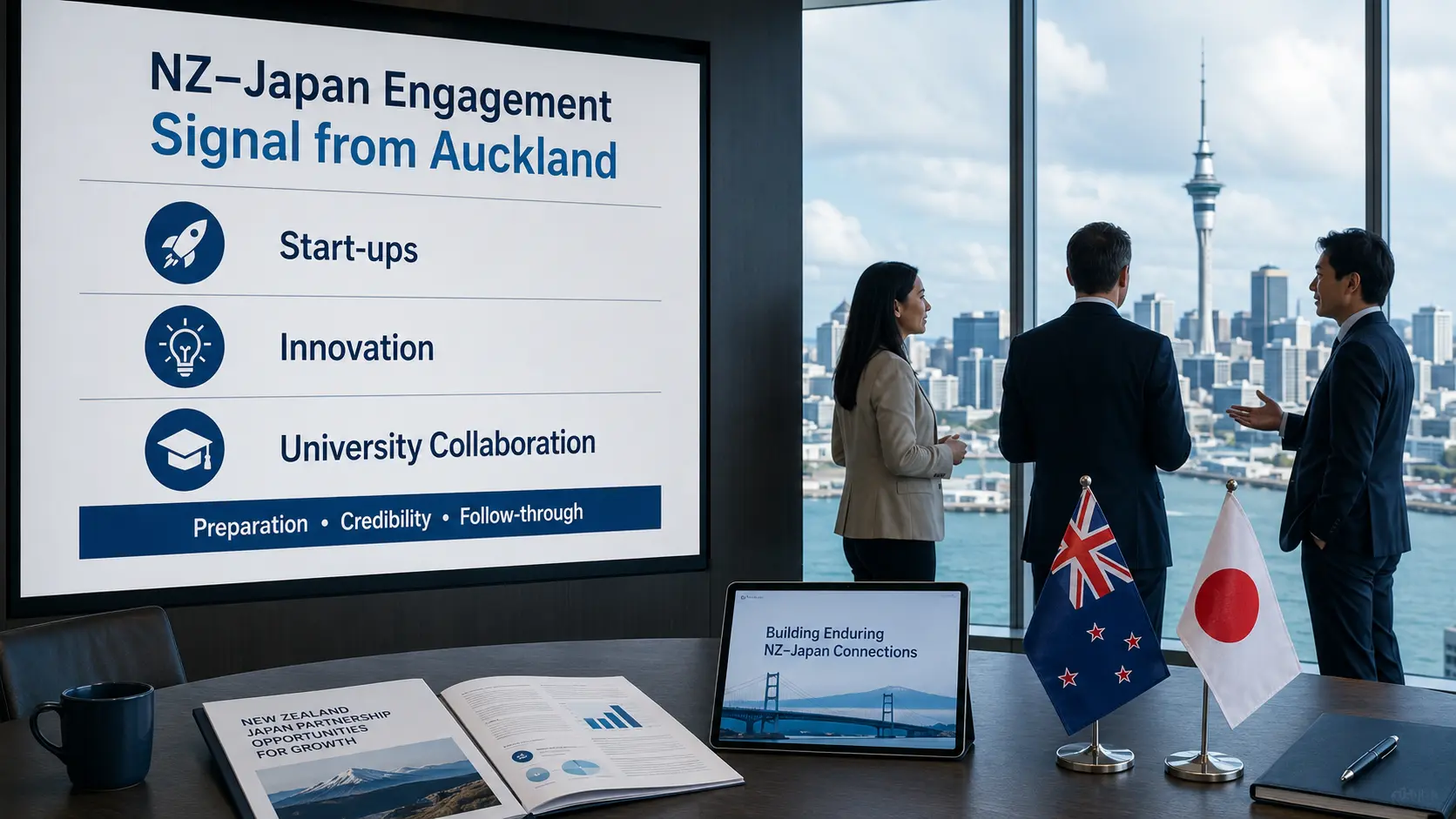
A recent LinkedIn post from MFAT in Auckland highlighted three areas for deeper engagement between New Zealand and Japan:
- start-ups
- innovation
- university collaboration
The post welcomed Japan’s new Consul-General in Auckland, Suguru Minoya, and noted his previous diplomatic experience in Wellington and Boston.
For NZ businesses, universities, research organisations, and innovation-led companies, the significance is not simply the appointment itself. It is the indication that these three areas are seen as having further potential for New Zealand–Japan engagement.
Why This Signal Matters
Opportunities in Japan’s innovation ecosystem are rarely limited to finding a buyer or distributor.
Depending on the technology, sector, and stage of development, a New Zealand organisation may need to engage with:
- Japanese companies
- universities and research institutes
- investors and venture capital firms
- accelerators and innovation hubs
- industry associations
- central or local government-linked organisations
Each type of organisation has different priorities, decision-making processes, and expectations of an overseas partner.
A Japanese company may be assessing commercial application, scalability, implementation risk, and internal alignment.
A university or research institute may place greater emphasis on research credibility, intellectual property, technical compatibility, and the proposed structure of the collaboration.
An investor may focus on market potential, management capability, governance, and whether the New Zealand organisation has the resources to support activity in Japan.
The opportunity may be attractive, but the route from an initial introduction to a commercial or institutional outcome is not always direct.
Institutional Interest Is Not Market Readiness
The MFAT in Auckland post does not announce a new programme, funding stream, or formal initiative.
It should not be interpreted as a guarantee of government support or as evidence that specific commercial opportunities are immediately available.
It does, however, provide a useful indication of where stronger New Zealand–Japan connections may develop. This could create more opportunities for introductions, delegations, events, institutional discussions, and collaborative activity.
For NZ organisations, the practical question is whether they are prepared to use those opportunities effectively.
An introduction may open a door. It does not remove the need for a clear proposition, credible preparation, and sustained follow-through.
Before approaching Japanese stakeholders, an organisation should be able to explain:
- what capability, technology, research, or commercial value it brings
- what type of Japanese partner it is seeking
- why that partner would benefit from the collaboration
- what a practical first step would involve
- what resources the organisation can commit after the initial introduction
- how communication and coordination will be managed over time
Without that preparation, even a well-supported introduction may result in a positive meeting but no clear next step.
Make the Japanese Partner’s Case Clear
NZ organisations often explain what they have developed, why it is innovative, and what they hope to achieve in Japan.
That information is necessary, but it is only one side of the proposition.
Japanese stakeholders also need to understand why the relationship is relevant to them.
The value may include:
- access to technology or specialist research capability
- a solution to a defined commercial or operational problem
- participation in a new market or technical field
- access to New Zealand testing, research, or development environments
- stronger university or industry connections
- a credible pathway from research to commercial application
The proposition should therefore answer three separate questions:
- What does the New Zealand organisation bring?
- What does the Japanese organisation gain?
- What would both parties need to do to turn the discussion into a workable project?
A proposition that answers only the first question is unlikely to be sufficient.
The Japanese partner’s commercial, technical, or institutional case needs to be as clear as the New Zealand organisation’s own objective.
Execution After the Introduction
Japanese organisations may involve several internal stakeholders before making a commitment.
Technical credibility, organisational stability, documentation, implementation planning, and risk management can matter as much as the initial idea.
This means the work does not end once a meeting has been secured.
NZ organisations need to be ready to:
- provide accurate and commercially relevant information
- identify the appropriate decision-makers and technical stakeholders
- respond clearly to detailed questions
- document agreed actions and responsibilities
- maintain a consistent communication rhythm
- follow up within agreed timeframes
- allocate sufficient internal resource to support the relationship
Language capability can help, but Japan capability is not simply a language function.
Japanese-speaking employees or advisers may support communication, but the organisation still needs the commercial and operational capability to manage stakeholders, maintain momentum, coordinate technical discussions, and deliver on agreed actions.
The objective is not simply to communicate with a Japanese organisation. It is to give that organisation confidence that the New Zealand side can support the relationship consistently.
The Relevance of the New Consul-General’s Background
Consul-General Minoya has previously served at the Embassy of Japan in Wellington and as Deputy Consul-General in Boston.
That background is relevant to the sectors highlighted in the MFAT in Auckland post.
His Wellington experience provides existing familiarity with New Zealand, while Boston is internationally recognised for its concentration of universities, research institutions, technology companies, start-ups, investors, and innovation networks.
It would be premature to assume that this background will lead to specific programmes or commercial opportunities.
However, it provides useful context for MFAT in Auckland’s emphasis on start-ups, innovation, and university collaboration.
For NZ organisations active in these areas, the appointment may create opportunities for stronger dialogue and more focused engagement. The value of those opportunities will depend on how clearly organisations present their capabilities and how effectively they support the relationship after the initial contact.
Bottom Line
The MFAT in Auckland post is not a funding announcement or a new market-entry programme.
It is a useful signal that start-ups, innovation, and university collaboration are areas where stronger New Zealand–Japan engagement may be encouraged.
For NZ businesses, universities, and research organisations, the opportunity is not simply to obtain an introduction.
The practical requirement is to arrive with:
- a clear proposition
- a defined partner profile
- a credible case for the Japanese side
- a realistic first step
- the internal capability to support the relationship over time
Institutional connections can open doors.
Sustained outcomes still depend on preparation, commercial credibility, and consistent follow-through.