
Getting a Product into Japan Is Not the Same as Building Demand
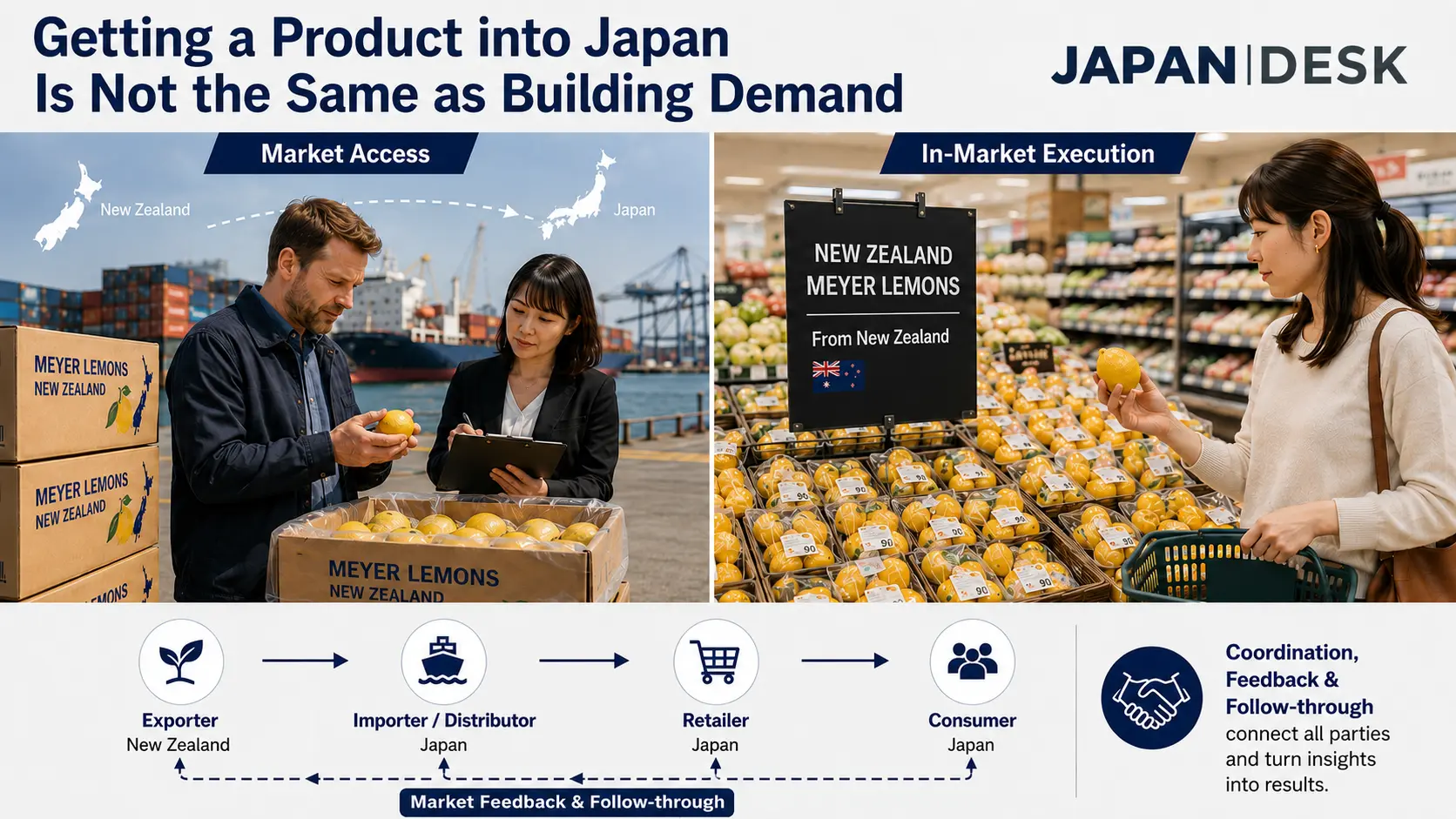
For New Zealand exporters, getting a product into Japan is not the same as building demand for it.
A recent meeting between New Zealand Meyer lemon growers and a Japanese retail co-operative illustrates the difference.
An article published on the Co-op Deli Consumers’ Co-operative Union website says that two New Zealand Meyer lemon growers visited its headquarters on 17 July 2026.
New Zealand-grown Meyer lemons are already sold through Co-op Deli group stores during the period when the supply of Japanese-grown lemons is lower.
During the meeting, one of the growers asked whether there were any ideas for encouraging more members of the co-operative to eat Meyer lemons.
A senior representative of the co-operative responded that lemons do not often appear on Japanese dining tables and said the two sides should work together on enjoyable ways of eating and using lemons.
The article does not prescribe a specific solution.
It does not say that the answer is a particular recipe, packaging change, promotional campaign or retail programme.
What it does show is commercially important.
The product has already entered Japan and reached retail stores. Yet the parties are still considering how to encourage more consumers to use it.
The question is no longer simply how to get the product into the market.
The question is how to build demand after it arrives.
Why It Matters
Market entry creates access. It does not automatically create consumer demand.
For an exporter, reaching Japanese stores can represent the completion of a long process:
- meeting regulatory and documentation requirements
- arranging logistics and supply
- establishing commercial relationships
- agreeing on pricing
- securing retail placement
- completing the first shipment
These are significant achievements.
However, they mainly answer one question:
Can the product be sold in Japan?
They do not necessarily answer a different question:
Why will Japanese consumers continue to buy it?
The distinction matters because a product can be present in the market without becoming part of the customer’s regular purchasing behaviour.
Availability gives consumers the opportunity to buy. It does not, by itself, give them a reason to do so.
The Market-Access Milestone Can Hide the Next Challenge
Exporters understandably focus on getting through the market-entry process.
Before the first shipment, the priorities are clear. The business needs an appropriate Japan-side partner, compliant documentation, workable logistics and a customer willing to purchase the product.
Once those elements are in place, the business may feel that the main commercial challenge has been solved.
In reality, a different phase has begun.
The exporter now needs to understand what happens between the product reaching the store and the consumer choosing it.
In the Meyer lemon example, the product is already available through a Japanese retail channel. The question raised during the meeting was not about whether the product could enter Japan.
It was about how to encourage more people to eat it.
That is an in-market execution question.
A Good Product Does Not Explain Itself
New Zealand exporters often have strong reasons to believe in their products.
A product may offer:
- reliable quality
- distinctive characteristics
- careful production
- strong provenance
- advantages over existing alternatives
- a credible New Zealand story
Those attributes may support its commercial potential.
However, the exporter still needs to determine whether the intended customer understands their relevance.
In the case of Meyer lemons, the co-operative’s website describes the fruit as having less acidity than a standard lemon. It also notes the quality of the New Zealand product and that post-harvest fungicides are not used.
These are product attributes.
The commercial question is whether those attributes influence the purchase decision of the intended Japanese customer.
That cannot be assumed from New Zealand.
It needs to be understood through the market.
For any product, the relevant questions may include:
- Does the customer recognise the product or variety?
- Do they understand how it differs from alternatives?
- Is that difference important to them?
- Does the product fit an existing purchasing or consumption occasion?
- What prevents an initial purchase?
- What prevents repeat purchasing?
- What are buyers, store staff and customers saying about it?
These are questions to investigate. They are not conclusions that should be reached without evidence.
Retail Placement Does Not Assign Responsibility for Demand
Another issue emerges once a product enters the Japanese market:
Who is responsible for developing demand?
The answer is not always clear.
The roles of importers, distributors and retailers differ between commercial arrangements.
An importer may be responsible for areas such as importation, compliance, documentation and supply.
A distributor may be responsible for introducing the product to customers, managing accounts and supplying the channel.
A retailer may decide whether to carry the product, where to place it and how it fits within the category.
These organisations may also contribute to market-development activity.
But the exporter should not assume that one of them automatically owns the long-term task of building the product’s position in Japan.
That responsibility needs to be discussed and assigned explicitly.
Without clear ownership, every party can fulfil its immediate role while the wider demand-development work remains incomplete.
The product arrives.
The distributor supplies it.
The retailer places it in stores.
But no one is necessarily responsible for connecting market feedback, commercial decisions and follow-through across the entire chain.
Someone Must Manage the Work Between the Parties
Market development in Japan often involves several organisations.
The exporter understands the product, its production capability and its broader commercial priorities.
The importer understands the import process and supply requirements.
The distributor understands the channel and its commercial customers.
The retailer has direct visibility of store operations, category performance and customer reactions.
Useful information may therefore exist across the entire commercial chain.
The challenge is connecting it.
Someone needs to be responsible for:
- maintaining communication between the New Zealand business and its Japanese partners
- collecting relevant feedback
- identifying the commercial issue behind that feedback
- agreeing on the next action
- confirming which party owns that action
- following up on decisions
- reporting developments to the New Zealand business
- assessing whether the response is improving performance
This is not simply a translation function.
It is not limited to arranging meetings or passing messages between parties.
It is a commercial execution function.
From Market Feedback to Practical Follow-Through
Meetings with Japanese partners can produce useful observations and constructive ideas.
The commercial value comes from what happens afterwards.
In the Meyer lemon meeting, the New Zealand side asked how more co-operative members could be encouraged to eat the product. The Japanese side identified the relatively limited presence of lemons on Japanese dining tables and expressed an interest in considering ways of using them together.
The article on the co-operative’s website does not say what action was agreed after that discussion.
It would therefore be incorrect to claim that a particular programme, campaign or product change will follow.
Nor does the article indicate whether the responsibilities discussed in this article are already being managed in this case.
The example simply illustrates a broader commercial principle: an observation raised in a meeting becomes commercially useful when it is translated into an operating process.
The business needs to establish:
- What was learned?
- What needs to be investigated further?
- Who will take the next action?
- When will the parties review the result?
- How will the information reach the exporter’s decision-makers?
Without that process, useful market information can remain separate from the decisions required to act on it.
This is how an execution gap can develop, even when the product, commercial relationships and intentions are all positive.
Feedback Must Reach People Who Can Act on It
A New Zealand exporter may have limited direct visibility of what is happening in Japanese stores.
Its Japanese partners may hear comments from buyers, store staff and customers that never reach the exporter in a structured form.
Even when feedback is shared, the exporter may not have a clear internal process for responding.
This creates two separate risks.
The first is an information gap.
The business does not fully understand how the market is responding to the product.
The second is an action gap.
The information reaches the business, but no one has the responsibility, authority or resources to act on it.
A workable market-feedback process therefore needs more than occasional updates.
It should establish:
- what information the exporter needs
- who will collect it
- how often it will be discussed
- who within the New Zealand business will review it
- who can approve a response
- how agreed actions will be tracked
The objective is not to collect every comment.
It is to identify information that can improve commercial decisions.
Strategic Implications for New Zealand Exporters
Before entering Japan, or before expanding an existing presence, NZ exporters should clarify the operating model that will apply after the product reaches the market.
Define Ownership
The business should identify who is responsible for monitoring and developing in-market performance.
The answer may be the exporter, a Japanese partner, an external resource or a combination of parties.
What matters is that the responsibility is explicit.
Separate Partner Roles
Importation, distribution, account management, retail placement and market development are related but different functions.
The exporter should understand which organisation is responsible for each one.
Establish a Communication Rhythm
Regular communication makes it easier to identify changes, respond to issues and maintain partner confidence.
Waiting until sales weaken or an order is reduced is not an effective reporting system.
Agree on Useful Information
The exporter should determine which information will help it make decisions.
Depending on the product and channel, this might include sales movement, repeat orders, buyer comments, store feedback, customer questions or changes in retail coverage.
Maintain Decision-Making Capability in New Zealand
The exporter must be able to respond when the market identifies an issue or opportunity.
Feedback is of limited value if no one can approve changes, allocate resources or coordinate the response.
Retain Resources for the Post-Entry Phase
Reaching the market is not the final expenditure.
The business still needs management time and execution capacity after the first shipment.
The appropriate level of investment should be based on evidence and commercial potential, not assumption.
Japan Capability Is an Execution Capability
Japan capability is sometimes treated mainly as a language requirement.
Language is valuable, but it is only one part of the function.
The person managing the market also needs to understand:
- the exporter’s commercial priorities
- the responsibilities of each Japanese partner
- how to communicate with buyers and distributors
- how to identify the issue behind market feedback
- how to coordinate decisions across organisations
- how to maintain follow-through over time
A Japanese-speaking employee may have these capabilities.
A Japanese distributor may provide some of them.
Neither should be assumed solely on the basis of language, nationality or job title.
The relevant question is whether the operating model provides the commercial execution required.
The Japan Desk Perspective
Japan is not harder. Japan is different.
A product may complete the import process, secure a Japanese customer and reach retail stores while still requiring substantial work to build consistent demand.
That does not mean the market has rejected the product.
It means market access and market development are different stages.
Japan rewards businesses that communicate consistently, respond to feedback and follow through on decisions.
Japanese partners need confidence that the New Zealand business will remain engaged after the initial agreement or shipment.
That engagement does not require the exporter to control every activity in Japan.
It requires the exporter to know:
- what is happening in the market
- what its partners are reporting
- what decisions are required
- who owns the next action
- whether agreed actions have been completed
Japan Desk supports this part of the operating model.
Our role is not to replace the importer, distributor or retailer.
It is to help manage the practical coordination, communication, market feedback and follow-through between NZ businesses and their Japan-side partners.
Bottom Line
Getting a product into Japan is an important commercial achievement.
It is not the same as building demand.
The New Zealand Meyer lemon example shows a product that has already reached Japanese stores, while the parties continue to consider how to encourage more consumers to eat it.
For NZ exporters, the key question is therefore not only:
Who can get our product into Japan?
It is also:
Who will manage the work required to build demand after it arrives?
Market access creates the opportunity to sell.
In-market execution determines whether that opportunity develops into consistent commercial performance.
Source: Co-op Deli Consumers’ Co-operative Union, “New Zealand lemon growers visit Co-op Deli Consumers’ Co-operative Union”, 20 July 2026.