
What Is New Zealand Exporting to Japan? A Closer Look at the Trade Data
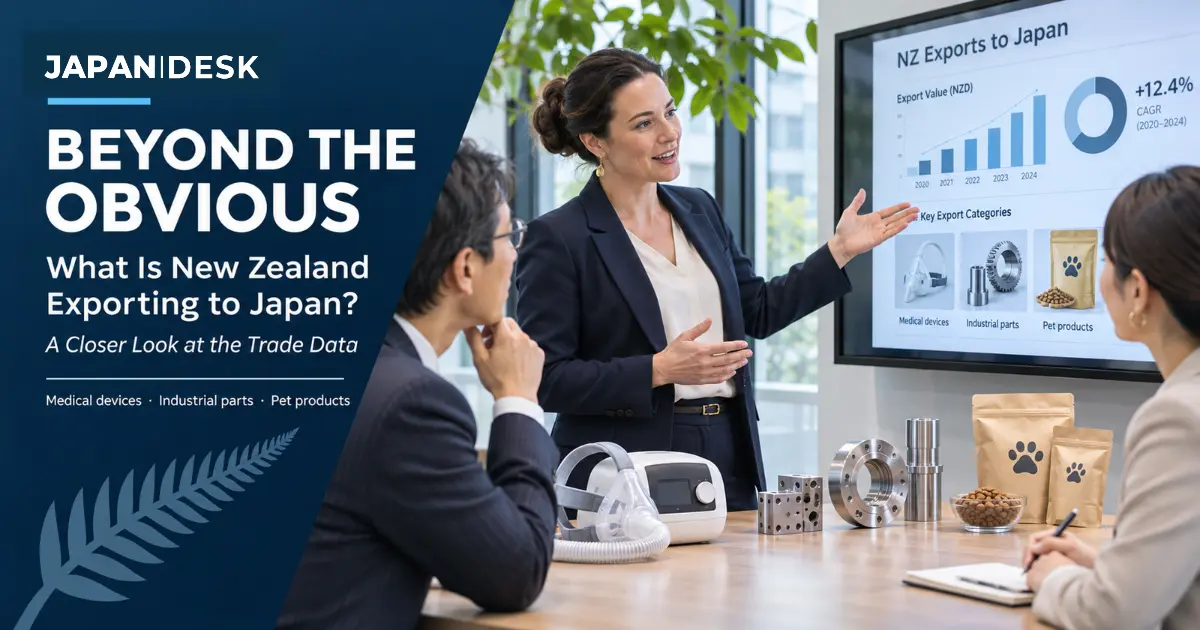
Part One: Products, industries and opportunities for New Zealand businesses
Japan has long been one of New Zealand’s most important export markets.
According to the Ministry of Foreign Affairs and Trade (MFAT), New Zealand exported NZ$4.85 billion worth of goods and services to Japan in the year ended June 2026, an increase of 6.4% on the previous year. Japan was New Zealand’s fourth-largest export market.
Dairy products, kiwifruit, aluminium, meat and timber are among our best-known exports to Japan.
But what else are New Zealand businesses supplying to the Japanese market?
And beyond the major export industries, where might smaller manufacturers and specialist businesses find opportunities?
To explore these questions, Japan Desk analysed Japanese Customs import data covering August 2025 to July 2026.
We examined New Zealand’s largest goods export categories, the specific products behind those figures, and smaller product categories where trade with Japan has been increasing.
The data reveals a much broader range of products than the usual headline export figures suggest.
For New Zealand businesses considering Japan, the most useful finding may not be the size of the largest export industries. It may be the evidence of existing trade in products closer to their own capabilities.
New Zealand’s largest goods exports to Japan
Japanese Customs recorded approximately NZ$4.46 billion worth of New Zealand-origin goods entering Japan between August 2025 and July 2026, converted from Japanese yen into New Zealand dollars.
The eight largest product categories were:
| Rank | Product category | Value recorded by Japanese Customs (12 months) |
|---|---|---|
| 1 | Dairy products, natural honey and related goods | NZ$752.7m |
| 2 | Fruit and related products | NZ$736.9m |
| 3 | Aluminium and aluminium products | NZ$575.4m |
| 4 | Meat and edible offal | NZ$474.4m |
| 5 | Casein and other protein-related products | NZ$379.0m |
| 6 | Wood and wood products | NZ$370.1m |
| 7 | Miscellaneous prepared foods | NZ$173.4m |
| 8 | Fish and seafood | NZ$130.8m |
Source: Japan Ministry of Finance, Customs import statistics for New Zealand-origin goods, August 2025–July 2026. Categories are based on two-digit Harmonised System (HS) classifications. Values are Japanese import values converted into NZD using monthly average exchange rates.
The ranking confirms the importance of New Zealand’s established dairy, horticulture, meat and industrial materials sectors.
However, it also highlights categories that receive less public attention, including protein ingredients and processed food products.
There is another important distinction.
A broad trade category does not necessarily reveal which specific products New Zealand is supplying.
For example, the official customs category covering fruit also includes nuts. But almost all of New Zealand’s trade in that category is kiwifruit.
Understanding what is actually being exported requires looking beyond the category headings.
What products are behind the major export figures?
Dairy: cheese accounts for most of the trade
Dairy products, natural honey and related goods were the largest category, with a recorded import value of NZ$752.7m.
The main products were:
| Product | Import value |
|---|---|
| Cheese and curd | NZ$514.3m |
| Butter and other dairy fats | NZ$103.5m |
| Milk powder and concentrated milk products | NZ$79.1m |
| Natural honey | NZ$44.3m |
| Whey and related products | NZ$11.3m |
Cheese alone accounted for approximately 68% of the total.
Natural honey was also a substantial category, at NZ$44.3m.
Although honey is not a dairy product, international customs classifications place it within the same broader HS chapter.
The honey figure includes mānuka and other types of natural honey. The customs data does not separately identify the value of mānuka honey.
For a New Zealand honey producer considering Japan, that distinction matters. The NZ$44.3m figure confirms existing trade in natural honey, but it does not establish the size of Japan’s mānuka honey market.
Fruit: kiwifruit accounts for 92.5%
Fruit and related products were the second-largest category, valued at NZ$736.9m.
| Product | Import value |
|---|---|
| Fresh kiwifruit | NZ$681.3m |
| Fresh apples | NZ$40.7m |
| Other fruit and related products | Approximately NZ$14.9m |
Kiwifruit accounted for approximately 92.5% of this category.
The official HS classification includes fruit and nuts, but the data showed no imports of New Zealand-origin nuts under HS0801 or HS0802 during the period examined.
In practical terms, this is overwhelmingly a kiwifruit export category, with apples making up much of the remaining value.
For New Zealand growers, the distinction is important.
A large headline figure for fruit does not mean every type of fruit has an equally established market in Japan.
The relevant question is how much Japan already buys of the particular product a grower can supply.
Aluminium: predominantly unworked metal
Aluminium and aluminium products accounted for NZ$575.4m.
Of that total, approximately NZ$574.8m was unworked aluminium.
This reflects a major trade in industrial material rather than a broad range of finished aluminium products.
A New Zealand manufacturer producing specialist aluminium components therefore cannot use the overall aluminium export figure as a measure of demand for its own products.
It needs to investigate the relevant finished-product category and the Japanese manufacturers that might purchase those components.
Meat: beef, sheep meat and edible offal
Meat exports to Japan extend beyond beef.
| Product | Import value |
|---|---|
| Frozen beef | NZ$189.9m |
| Fresh or chilled beef | NZ$117.8m |
| Sheep and goat meat | NZ$97.6m |
| Edible offal | NZ$67.6m |
Beef accounts for a substantial share, but sheep meat and edible offal also represent significant trade.
Different products within the meat industry may serve very different customers.
A supplier of specialist cuts, ingredients or processed products needs to understand the buyers and commercial requirements for its specific product, rather than relying on the size of the overall meat trade.
Protein-related products: more valuable than timber exports
One of the less obvious findings is the scale of trade in casein and other protein-related products.
Japanese Customs recorded NZ$379.0m in this category.
| Product category | Import value |
|---|---|
| Casein, caseinates and related products | NZ$142.8m |
| Peptones and other protein substances | NZ$124.3m |
| Albumins and related products | NZ$108.0m |
These products can be used in food manufacturing and industrial applications.
They are not usually the first products mentioned when discussing New Zealand’s exports, yet the category exceeds the value of our wood and wood products trade with Japan.
It illustrates an important point for New Zealand businesses:
A substantial part of our export trade is business-to-business, involving ingredients, materials and components rather than finished consumer products.
For specialist manufacturers and ingredient suppliers, understanding these B2B markets can be more useful than focusing on consumer retail trends.
Wood: processed products also play a major role
Wood and wood products accounted for NZ$370.1m.
This included approximately NZ$158.1m in fibreboard products, including MDF, and around NZ$85.2m in a category covering fuel wood, wood chips and related materials.
Raw materials and processed wood products can serve different industries and buyers.
For New Zealand businesses considering Japan, the distinction between supplying a commodity and supplying a product with particular specifications is commercially important.
The route to market may be quite different.
Beyond the major exporters: opportunities worth investigating
Large export figures help explain the scale of New Zealand’s trade with Japan.
But for a New Zealand SME, the largest market is not necessarily the most suitable one.
A more practical starting point is to ask:
- Does Japan already buy products similar to ours from New Zealand?
- Which Japanese businesses might need our product?
- What technical, commercial or supply requirements would we need to meet?
- Can we offer something that existing suppliers do not?
Looking at the trade data from this perspective reveals a much wider range of industries worth investigating.
These include specialised manufacturing, healthcare, construction products, pet products, consumer goods, beauty products, food and beverages.
| Industry | New Zealand-origin products recorded by Japanese Customs | Import value (12 months) |
|---|---|---|
| Medical devices and healthcare | Respiratory therapy equipment | NZ$53.5m |
| Specialised manufacturing | Parts and accessories classified for semiconductor and flat-panel display manufacturing equipment | NZ$30.8m |
| Construction and metal fabrication | Certain iron or steel structures and structural parts | NZ$22.4m |
| Pet products | Retail-packed dog and cat food | NZ$29.2m |
| Household products | Certain retail cleaning preparations | NZ$2.7m |
| Beauty and personal care | Certain beauty and skincare preparations | NZ$1.85m |
| Food and beverage manufacturing | Fruit and vegetable juices | NZ$48.0m |
| Natural food products | Natural honey | NZ$44.3m |
| Processed foods | Sauces and mixed seasonings | NZ$27.1m |
| Frozen foods and dairy | Ice cream and other edible ice | NZ$24.5m |
| Wine | Wine | NZ$21.8m |
| Horticulture | Fresh apples | NZ$40.7m |
| Food ingredients | Frozen vegetables | NZ$19.4m |
| Horticulture | Large sweet capsicums | NZ$15.1m |
Source: Japanese Customs import statistics, August 2025–July 2026. Values have been converted from JPY into NZD. Products are based on specific customs classifications. Some also appear within the broader categories in Section 2.
The table is not a ranking of the best industries to enter.
It does not tell us how easy it would be for another New Zealand supplier to win business, or how much revenue a new entrant could achieve.
What it does establish is that products across these industries are already being supplied from New Zealand to Japan.
That is a useful starting point for more targeted market research.
Specialised manufacturing and industrial components
One category worth examining is parts and accessories for equipment used in semiconductor and flat-panel display manufacturing.
Japanese Customs recorded NZ$30.8m of New Zealand-origin goods under this classification over the 12-month period.
These are not semiconductor chips.
The classification covers parts and accessories associated with specialised manufacturing equipment. It does not identify the exact components, their manufacturers or the businesses purchasing them.
That distinction is important.
New Zealand is not being presented here as a major semiconductor chip exporter.
Rather, the trade data confirms that New Zealand-origin products are being supplied into a specialised manufacturing equipment category.
For New Zealand businesses involved in precision engineering, machining, industrial equipment or component manufacturing, this is a relevant area to investigate.
However, supplying Japanese manufacturers requires more than having a technically capable product.
Potential customers may have detailed requirements for specifications, quality assurance, production capacity, delivery reliability and technical support.
A supplier needs to establish whether its capabilities match the needs of particular Japanese businesses.
There is also trade in iron and steel structures and structural parts, with NZ$22.4m recorded in one relevant customs category.
For New Zealand companies producing specialised fabricated components or construction-related products, this provides another area for investigation.
The important question is not how large Japan’s entire construction or manufacturing industry might be.
It is whether there are Japanese businesses with a specific requirement that the New Zealand supplier can meet.
Medical devices and healthcare
Japan received NZ$53.5m worth of New Zealand-origin respiratory therapy equipment during the reporting period.
This is an established trade in specialised medical technology.
For New Zealand medical device manufacturers, the figure provides a reason to investigate the Japanese market more closely.
However, medical devices require careful assessment of regulatory and commercial conditions.
Depending on the product, these may include regulatory classification, approvals, distribution arrangements, servicing and technical support.
Businesses need qualified specialist advice on the applicable requirements before making market entry decisions.
The commercial challenge is then to identify suitable Japanese distributors, healthcare suppliers or other business partners and establish whether the proposed arrangement is commercially workable.
Japan Desk can assist with commercial research and partner development, while regulatory matters remain the responsibility of appropriately qualified specialists.
Pet products, beauty and household goods
New Zealand consumer products are also reaching the Japanese market.
Japanese Customs recorded NZ$29.2m in retail-packed dog and cat food from New Zealand.
There were also imports worth NZ$2.7m in a specified category of retail cleaning preparations, and NZ$1.85m in a category of beauty and skincare preparations.
These categories may be relevant to New Zealand pet product manufacturers, skincare brands and household product businesses.
But existing export activity does not guarantee that another supplier will succeed.
A company needs to understand what is already available in Japan and why a buyer might choose its product.
That reason could be product performance, ingredients, design, a specialist application, pricing or a clear point of difference.
The next step is finding Japanese importers, distributors, retailers or other partners whose customers would value those features.
For a smaller New Zealand brand, the right specialist partner may be more useful than attempting to reach the broadest possible retail market.
Food, beverages and specialist ingredients
Food and beverages remain important areas of New Zealand’s trade with Japan.
Beyond major exports such as cheese, meat and kiwifruit, there is established trade in sauces, juices, honey, ice cream, wine and other processed products.
For example, Japan recorded NZ$27.1m in imports of New Zealand-origin sauces and mixed seasonings during the 12-month period.
For a New Zealand sauce manufacturer considering Japan, the first step is not necessarily to seek a nationwide supermarket listing.
A specialist importer, premium food retailer or foodservice supplier might be a more suitable partner, depending on the product and the manufacturer’s capabilities.
The same applies to food ingredients.
A company supplying an ingredient to food manufacturers may need a different approach from a business selling finished products under its own brand.
In both cases, the essential questions are similar.
Who would buy the product? Why would they choose it? What volumes and commercial conditions would make the arrangement worthwhile?
The right Japanese customer matters more than the headline market size
These examples show that New Zealand’s trade with Japan extends across a wide range of industries.
But the existence of trade in a particular product category is only the starting point.
A specialist component manufacturer may need direct contact with the engineering or procurement team of a Japanese manufacturer.
A pet product company may need an importer with access to specialist retailers.
A food ingredient supplier may be better suited to approaching Japanese food manufacturers directly.
Different products require different approaches.
The objective is to find Japanese businesses that have a genuine reason to buy what your company can supply.
Identifying those businesses, assessing their suitability, making contact and progressing commercial discussions are among the activities Japan Desk undertakes as an outsourced business development team specialising in the Japanese market.
Which New Zealand products are recording growth in trade with Japan?
Annual trade figures show which products New Zealand is already supplying to Japan.
But it is also useful to understand which areas have recorded increases more recently.
To examine this, we compared Japanese Customs data for January–July 2026 with the same period in 2025.
The following New Zealand-origin products recorded increases in both import value and quantity.
| Product | Total import value (Aug 2025–Jul 2026) | Change in value (Jan–Jul 2026) | Change in quantity (Jan–Jul 2026) |
|---|---|---|---|
| Frozen sheep meat, bone-in cuts | NZ$20.3m | +253.0% | +216.8% |
| Frozen berries, including raspberries and blackberries | NZ$2.3m | +140.1% | +175.3% |
| Fresh onions and shallots | NZ$13.6m | +70.7% | +64.9% |
| Prepared or preserved mussels | NZ$11.3m | +26.2% | +30.3% |
How to read the figures
The total import value covers the 12 months from August 2025 to July 2026.
The percentage changes compare January–July 2026 with January–July 2025. Changes in value are calculated in NZD using the average exchange rate for each month.
For example, the 253.0% increase in frozen sheep meat means that Japan’s recorded import value for this New Zealand-origin product was 253.0% higher in January–July 2026 than in the equivalent period of 2025.
It does not mean that the 12-month total of NZ$20.3m increased by 253.0%.
Several other consumer-oriented categories also recorded increases in import value over the same seven-month comparison period.
| Product | Change in import value |
|---|---|
| Fruit and vegetable juices | +26.8% |
| Ice cream and other edible ice | +20.3% |
| Sauces and mixed seasonings | +4.1% |
| Retail-packed dog and cat food | +2.6% |
These changes are worth examining, but they need to be interpreted carefully.
An increase in Japanese imports from New Zealand does not necessarily mean Japanese demand for that product is growing overall.
A higher import value could reflect changes in quantity, pricing, product mix or shipment timing.
A large percentage increase can also occur when the previous year’s trade value was relatively small.
Frozen berries are an example. Their recorded import value increased sharply, but the total for the 12 months was still NZ$2.3m.
For New Zealand businesses, this means growth figures should be treated as a reason to investigate a market, not as proof of an opportunity.
The relevant questions are what has changed, why it has changed and whether the trend matters for the particular product a business intends to supply.
Finding the right route into Japan
Japan is a large market, but New Zealand businesses do not necessarily need to approach it on a large scale.
In our view, a more practical starting point is to identify customers and sales channels that match the product, business size and available resources.
Japan has many routes to market, including major supermarket chains, department stores, premium grocery retailers, specialist shops, wholesalers, foodservice distributors and online retailers.
These channels can have very different customers, purchasing requirements and supply expectations.
For example, a major retail chain may require substantial and consistent volumes, strict delivery arrangements, promotional spending and competitive pricing over time.
A buyer might see value in a New Zealand product but still be unable to proceed if the manufacturer cannot meet the required volumes or commercial conditions.
That does not mean a smaller New Zealand business needs to expand its production capacity before considering Japan.
A manufacturer offering a distinctive sauce or honey product may find a better starting point with a specialist importer or retailer whose customers value that type of product.
Beginning with a commercially workable volume can allow the business to establish trading relationships, assess market response and consider wider distribution later.
Of course, smaller orders do not automatically mean better profitability.
Freight, import costs, distribution margins and product preparation expenses must still be taken into account.
The same principle applies to industries outside food.
A specialist engineering company may find more value in supplying a small number of Japanese manufacturers with specific technical requirements than in trying to reach a broad market.
A healthcare technology company may need a commercial partner with knowledge of its particular product category and customer base.
A consumer brand may benefit from a distributor focused on a clearly defined segment rather than a general wholesaler.
The goal is not to make your business large enough for Japan. It is to find the part of the Japanese market that fits your business.
That requires more than identifying a promising industry.
Someone needs to research the relevant companies, identify decision-makers, make contact, explain the offer, respond to enquiries and follow up.
These are practical business development activities, and they are among the services Japan Desk provides to New Zealand businesses entering or expanding in the Japanese market.
From export data to business development
The trade figures show that New Zealand’s exports to Japan extend well beyond our best-known primary industries.
Specialised industrial components, medical equipment, pet products, household goods, beauty products and processed foods all feature in the data.
For New Zealand businesses, this is a useful reminder that Japan is not a market reserved for large exporters.
However, knowing that Japan already buys similar products is not the same as knowing whether your company can win business there.
Before committing resources to market entry, a company needs to understand its specific product category, the competing alternatives, potential customers, pricing, supply requirements and suitable routes to market.
And once potential customers have been identified, the work is not finished.
Someone still needs to make contact, establish credibility, progress discussions, respond to requests, agree on next steps and maintain the relationship.
This is where Japan Desk fits in.
Japan Desk is an outsourced Business Development team specialising in the Japanese market for New Zealand businesses.
We are not simply a translation or interpreting service, nor a consultancy that delivers a market research report and leaves the client to work out what happens next.
Depending on the scope of an engagement, we identify and approach potential business partners, prepare and coordinate meetings, support commercial discussions, manage communication and follow up on agreed actions.
Our role is to help New Zealand businesses move from identifying an opportunity in Japan to taking practical steps towards building commercial relationships.
Japan is not harder. Japan is different.
Understanding those differences is important. Knowing how to work through them is what turns market research into business development.
In Part Two, we look beyond physical goods to explore New Zealand’s services trade with Japan, including technology, specialist services and commercial relationships in the space sector.
Read Part Two: New Zealand Exports More Than Goods to Japan: Services and Business Opportunities
Sources and methodology
Trade data
- MFAT — Japan: Economic Update, October 2026
- Japan Customs — Trade Statistics
- Japan Customs — Tariff schedules and product classifications
- NZD/JPY exchange rates, 2025
- NZD/JPY exchange rates, 2026
Product-level figures were compiled from Japan’s Ministry of Finance import statistics for New Zealand-origin goods (country code 606), using the 2025 and 2026 annual data files.
The reporting period for total import values is August 2025 to July 2026.
The original Japanese Customs figures are recorded in Japanese yen on a CIF basis, which includes cost, insurance and freight.
Each month’s import value was converted into NZD using that month’s average NZD/JPY exchange rate. The converted monthly amounts were then added together.
Year-on-year percentage changes compare January–July 2026 with January–July 2025, using the respective monthly exchange rates for each year.
These NZD figures are indicative currency conversions. They do not represent the exchange rates necessarily received by individual New Zealand exporters.
The Japanese Customs figures are also not identical to New Zealand’s officially reported export values, which use different valuation methods and may cover different reporting periods.
Customs categories may contain several types of products. The data does not identify individual manufacturers or buyers, establish the size of the exporting businesses or indicate the market share available to a new supplier.
This article provides general market information. It does not constitute legal, tax, customs or regulatory advice.