
Setting Up a Company in Japan Now Requires NZ$321,000 in Capital. Here’s the Full Picture.
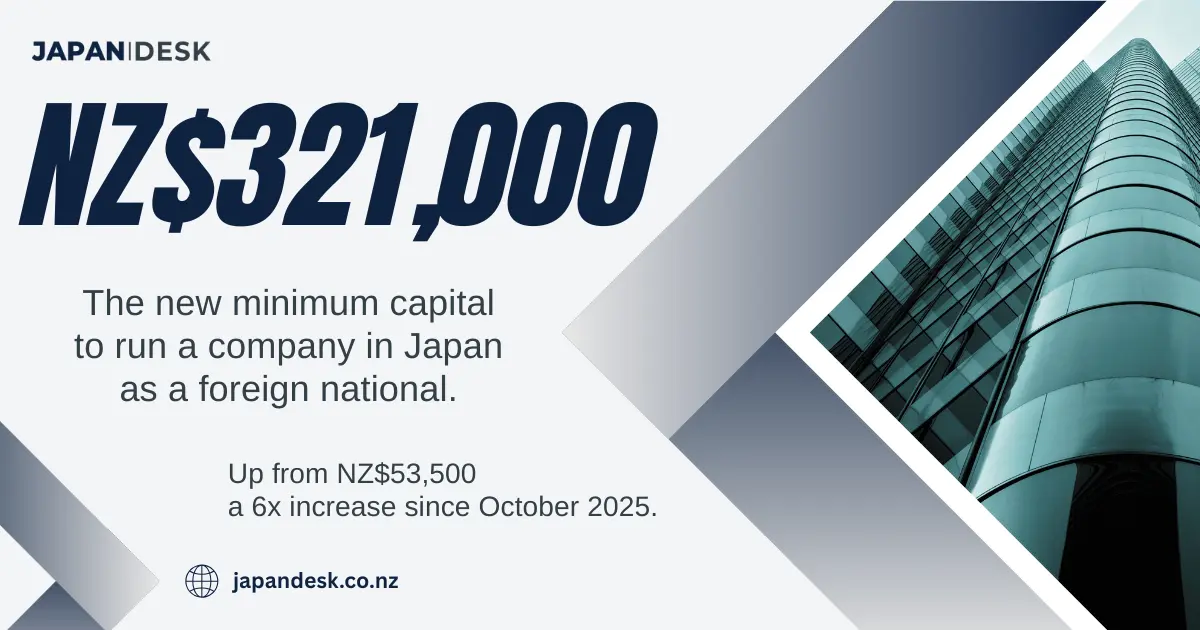
Japan raised the bar for foreign business owners in October 2025 — here’s what changed, what it costs, and why outsourcing your Japan presence is worth a serious look.
Exchange rate used throughout: NZ$1 ≈ ¥93.5 (as at time of publication)
First, a bit of context
If you want to run a company in Japan as a foreign national — as in, actually be on the ground there as the director — you need what’s called a Business Manager visa. It’s the gateway for any overseas company, including those based in New Zealand, that wants to set up a Japanese entity and have someone running it locally.
In October 2025, the Japanese government rewrote the rules. Seven months on, a lot of NZ businesses still haven’t clocked what that means for them.
What changed — and by how much
The big one: capital requirements went up sixfold
The minimum paid-up capital required to qualify for the visa has jumped from ¥5 million to ¥30 million.
| Before | After | |
|---|---|---|
| Minimum capital | ¥5 million (approx. NZ$53,500) | ¥30 million (approx. NZ$321,000) |
That’s an extra NZ$267,000 that now needs to sit in a Japanese company account before a visa application will even be considered. Not a loan. Not a line of credit. Demonstrably yours, with a paper trail to prove it.
Five new requirements that didn’t exist before
On top of the capital increase, five entirely new conditions have been introduced.
① You must employ at least one full-time staff member in Japan
A sole-director company no longer cuts it. You need at least one full-time employee, based in Japan, on a proper employment contract with social insurance. The average salary for a full-time employee in Japan runs around ¥4–5 million per year (roughly NZ$43,000–53,000), and that’s before the employer’s share of social insurance contributions on top.
② Someone in the business must be able to speak Japanese — properly
Either the director or at least one full-time employee must demonstrate Japanese language ability at CEFR B2 level or above. In plain terms, that’s working-level fluency — capable of handling day-to-day business without a translator in the room.
The accepted proof includes:
- JLPT (Japanese Language Proficiency Test) at N2 level or above
- BJT Business Japanese Proficiency Test score of 400 or above
- 20+ years of continuous residence in Japan
- Graduation from a Japanese university or vocational college
- Completion of Japanese compulsory education through to high school
Getting to JLPT N2 from scratch takes most people several years of serious study. Hiring someone who already has it is the practical workaround — but that person needs to be physically based in Japan. A Japanese-speaking team member sitting in Auckland doesn’t satisfy the requirement.
③ Your business plan needs a professional sign-off
A business plan reviewed and confirmed by a qualified professional — a certified public accountant, tax accountant, or registered management consultant — is now mandatory. The intent is clear: the government wants a third party to vouch that the business is real and the numbers stack up.
④ The director needs a track record
The applicant must have either a postgraduate degree (master’s or above) in a relevant field, or at least three years of hands-on management experience. First-time founders with no formal management credentials will find this harder to satisfy than they might expect.
⑤ You need a proper, standalone office
Working from home is out. Virtual offices are out. Hot-desking in a shared space is out. The regulations now require a physically separate, dedicated business premises — its own entrance, clearly distinct from any residential space, under a commercial lease in the company’s name.
For a New Zealand business, the rental cost itself probably won’t be what stings. The issue is what renting an office in Japan actually entails. It triggers a chain of obligations — company registration, banking, bond payments, ongoing compliance — and when you factor in the full-time staff requirement alongside it, you’re not just renting a room. You’re committing to running a fully operational Japanese company, indefinitely. That’s a very different proposition from testing the market.
The compliance bar has been raised too
Tax and social insurance payment history will now be checked as part of both new applications and renewals. If your Japanese entity has any gaps in its compliance record, that becomes a problem at renewal time.
What the numbers say
Tokyo Shoko Research surveyed 299 foreign-owned businesses in Japan earlier this year about the impact of these changes. The results are sobering.
How companies expect to be affected:
| Response | Share |
|---|---|
| No significant impact | 54.8% |
| Will hire staff or restructure to comply | 27.4% |
| Considering sale or merger of the business | 11.7% |
| Planning to transfer ownership to a Japanese national | 6.3% |
| Considering closing the business entirely | 5.3% |
Nearly half — 45.2% — reported some form of impact. One in twenty is looking at shutting up shop altogether.
The split between large and small companies tells the real story. Among large companies (capital over ¥100 million), 70% said they were unaffected. Among small and medium businesses, that dropped to 53.7%. The new rules land hardest on exactly the kinds of lean, early-stage operations that foreign entrepreneurs typically use to enter the Japanese market.
To put the capital requirement in perspective
Of all the companies incorporated in Japan in 2024, just 1.0% had paid-up capital of ¥30 million or more. More than 95% came in under ¥10 million (around NZ$107,000). This isn’t a threshold set for multinational subsidiaries — it’s a bar that the vast majority of Japanese-founded companies wouldn’t clear either. For a foreign business feeling its way into the market, NZ$321,000 locked up in a Japanese entity is a serious commitment.
Already have a visa? Don’t assume you’re fine
Existing Business Manager visa holders aren’t automatically exempt. When renewal comes around — typically every three years — applications will be assessed against the new criteria. The government has indicated some flexibility around “expected compliance” for renewals, but how that plays out in practice is still working itself out. If you or someone you work with holds this visa, get on top of your situation well before the renewal date.
What this means for NZ companies eyeing Japan
The short version: the cost and complexity of maintaining a direct presence in Japan just went up significantly. Capital locked away, a local hire, a Japanese-speaking employee, a standalone office, a certified business plan, a director with a management pedigree — each of these is manageable in isolation. Together, they represent a serious ongoing operational commitment, not just a one-off entry cost.
That’s precisely the environment where outsourcing your Japan market representation starts to make a lot of sense. Japan Desk gives NZ companies access to the Japanese market — sales, business development, partner relationships, communications — without the overhead of establishing and maintaining a local entity. The harder it gets to do it yourself, the stronger the case for having someone already there do it for you.
If you’re weighing up Japan, or you’re already in market and wondering whether your current setup still makes sense, get in touch.
Source: Tokyo Shoko Research, “2026 Survey on the Tightening of Business Manager Visa Requirements” (published 23 April 2026). Survey conducted 31 March – 7 April 2026, n=299.
Thinking about Japan, or already in market and wondering whether your current setup still makes sense?