
Japan as a Stability Market: Why New Zealand Companies Should Look Beyond Easy Market Entry
New Zealand is often described as one of the easiest countries in the world to start a business.
In many respects, that reputation is deserved. Company formation is straightforward, the regulatory environment is relatively transparent, and the domestic market is accessible for founders.
But starting a company and building a durable business are not the same thing.
That distinction matters.
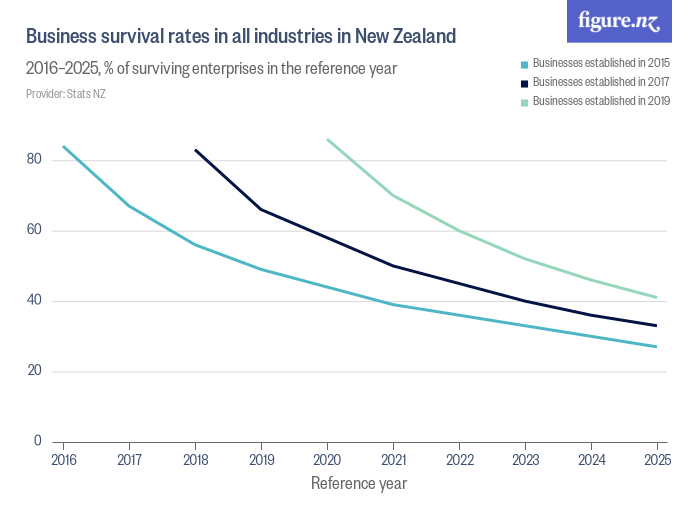
According to Stats NZ business demography data published through Figure.NZ, only 27% of enterprises born in 2015 were still surviving in 2025. Put another way, roughly three out of four did not reach the ten-year mark. The five-year view tells a similar story. Enterprises born in 2019 had a survival rate of 46% in 2024, meaning more than half were no longer surviving after five years.
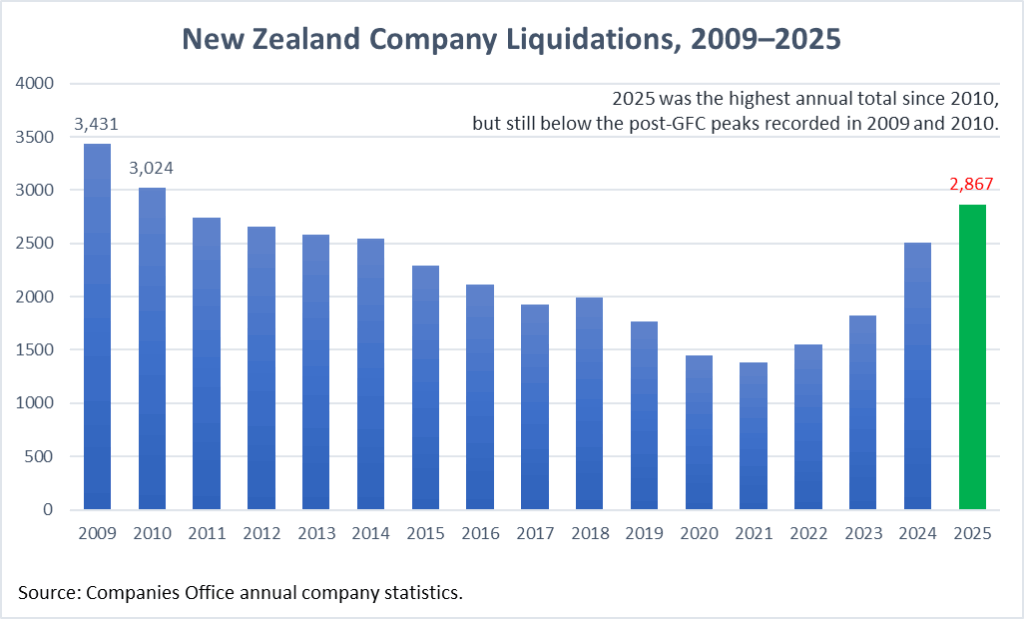
The pressure is also visible in liquidation numbers. Companies Office annual statistics show that 2,867 New Zealand companies went into liquidation in 2025, the highest annual total since 2010. While this remains below the post-GFC peaks recorded in 2009 and 2010, it still points to renewed pressure on business durability in New Zealand.
This is not a criticism of New Zealand.
It is a structural reality.
New Zealand is a good place to start, test, and build. It is a small, high-trust, high-quality market with relatively low barriers to entry. But its domestic scale is limited. For many businesses, the reachable customer base is quickly exhausted, growth capital can be difficult to secure, and long-term expansion eventually requires a broader market base.
This is where Japan deserves closer attention.
Not because Japan is easy.
It is not.
Japan is often described as conservative, detail-oriented, relationship-driven, and slow to enter. Those descriptions contain some truth. But they do not capture the more important commercial point.
Japan may not be the easiest market to enter. But for businesses that earn trust, it can become a valuable market to stay in.
Why the Data Matters
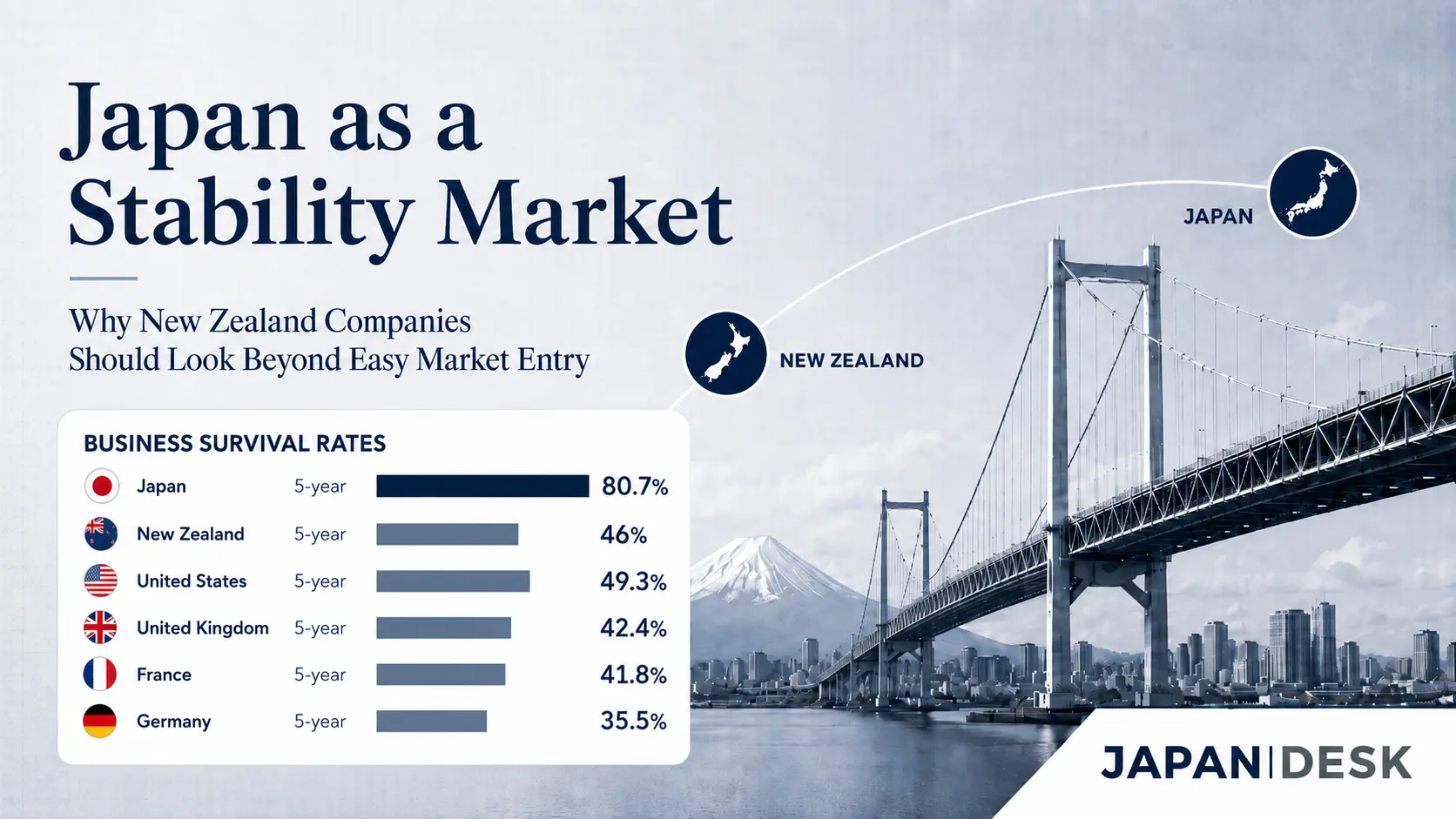
Japan’s 2023 White Paper on Small and Medium Enterprises states that the five-year survival rate for newly established businesses in Japan was 80.7%.
That figure should be read carefully.
The same section notes that Japan’s figure may be higher than the actual survival rate because of the characteristics of the underlying database and the time required for companies to be recorded in that database. It also cautions that international survival-rate data cannot be compared mechanically because statistical definitions and data characteristics differ by country.
That caveat is important.
But it does not make the data irrelevant.
It simply means the figures should be read as a strategic signal rather than a direct statistical comparison.
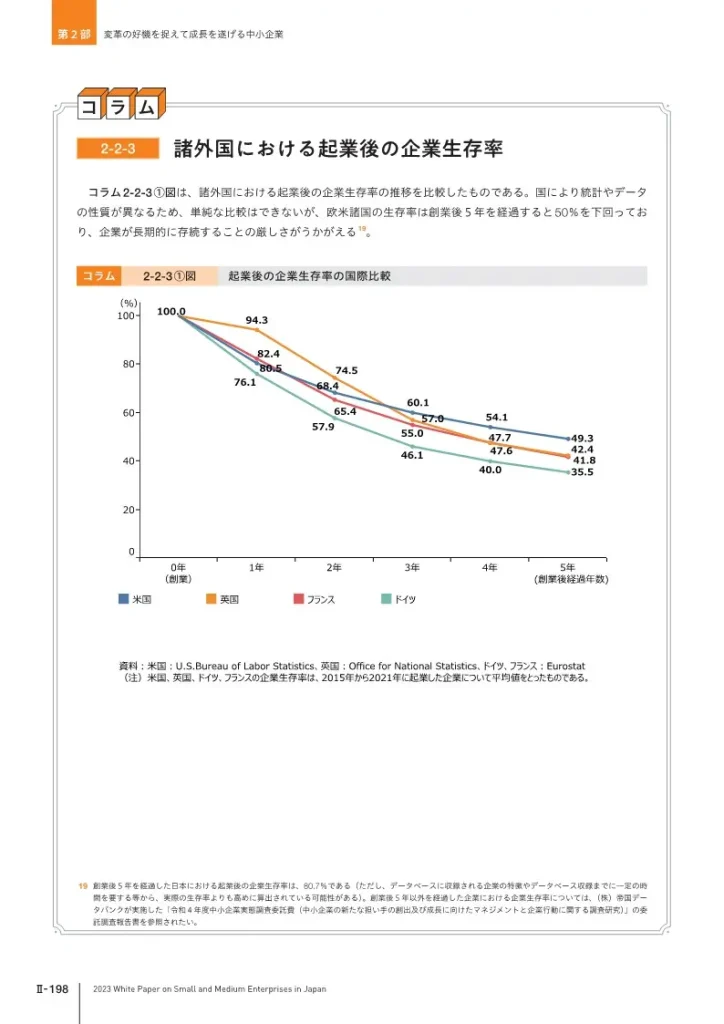
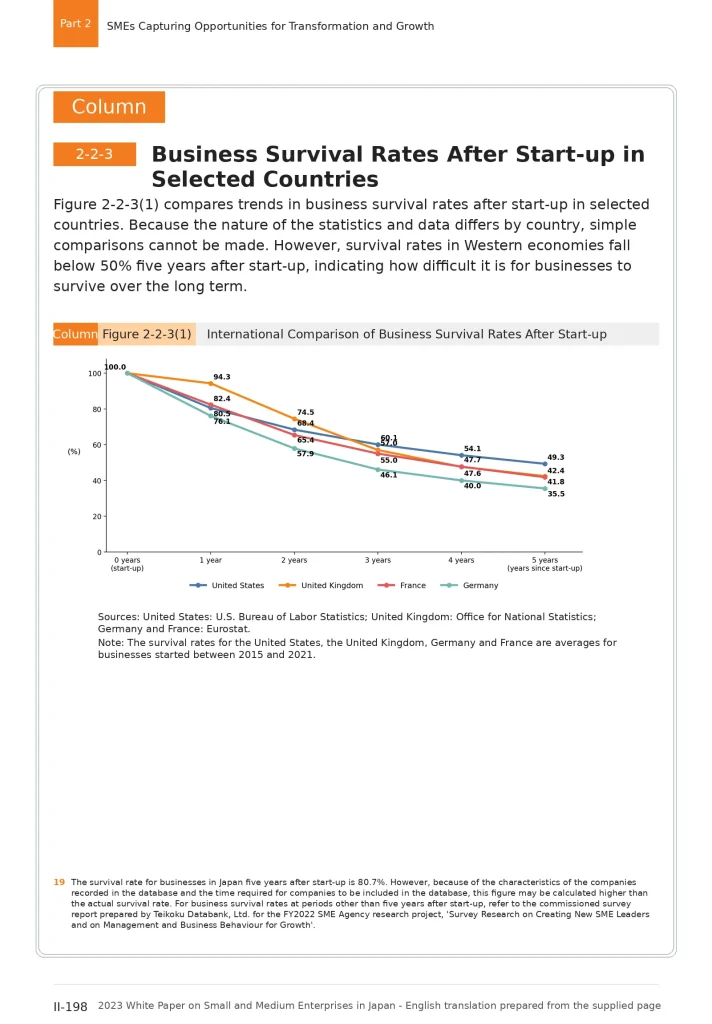
The White Paper also presents survival-rate data for businesses established in the United States, the United Kingdom, France, and Germany. In that comparison, the five-year survival rates were 49.3% in the United States, 42.4% in the United Kingdom, 41.8% in France, and 35.5% in Germany.
New Zealand is not included in that White Paper comparison. However, the five-year New Zealand figure noted earlier provides useful context: enterprises born in 2019 had a survival rate of 46% in 2024.
These figures should still be treated carefully. They come from different statistical systems, definitions, and time periods.
Nor do they prove that Japan is automatically safer, easier, or more attractive than other markets.
The more useful point is that market environments differ not only in how easy they are to enter, but also in the kind of business behaviour they reward over time.
Some markets are built around speed, access, and rapid customer acquisition.
Others place greater value on continuity, trust, preparation, reliability, documentation, and long-term commitment.
Japan belongs in the second category.
For New Zealand companies, that distinction matters.
New Zealand is a strong environment for starting, testing, and proving a business. But a company that wants to endure cannot rely only on ease of formation or access to a small domestic market.
It needs markets, partners, and operating disciplines that support durability.
That is why Japan should not only be viewed as a growth opportunity.
It should also be considered as a stability market.
Japan Is Not Just a Growth Market
New Zealand companies often think about overseas markets in terms of access, speed, and growth.
How quickly can we enter?
How easily can we sell?
How fast can we scale?
Those are valid questions.
But they are not the only questions that matter.
A more useful question for many New Zealand companies is:
Can this market help us build a more resilient business?
That is where Japan becomes strategically interesting.
Japan is not simply a large consumer market. It is a market where trust, reliability, documentation, product consistency, and partner discipline carry significant commercial weight.
Those expectations can be demanding. They can slow early progress. They can require more preparation than New Zealand businesses are used to.
But they also create a different kind of value.
Once a Japanese partner has confidence in a supplier, the relationship is not usually treated as disposable. Price matters, but it is rarely the only factor. Reliability, communication, supply consistency, claim accuracy, after-sales support, and long-term commitment all influence the decision to continue.
For the right New Zealand company, that can make Japan more than an export destination.
It can make Japan a stability market.
What This Means for New Zealand Companies
Entering Japan does not mean establishing a Japanese company on day one.
In many cases, that is not the right first step.
A more practical approach is to begin with market validation, partner search, localisation, pricing checks, compliance review, and commercial channel development.
A New Zealand company can explore Japan as a business market before deciding whether it needs a local entity.
Japan market entry can begin with customers, partners, distributors, agents, referral channels, licensing, product localisation, or B2B relationships. Corporate setup may come later, once the commercial case is clearer.
For a New Zealand business, a credible Japanese channel can do more than add revenue.
It can diversify demand beyond the domestic market. It can reduce dependence on a small local customer base. It can provide proof of quality in a market where reliability, documentation, and consistency carry real commercial weight. It can strengthen documentation, compliance discipline, customer support, product positioning, and internal execution.
In short, Japan can help a New Zealand company become more robust.
This is particularly relevant for sectors where New Zealand already has credibility: food and beverage, agritech, health and wellness, education, tourism, environmental solutions, advanced manufacturing, software, and niche B2B services.
Strategic Implications
The statistical point is not that Japan is automatically safer than New Zealand or other developed markets.
The more useful point is that Japan’s business environment appears to reward durability, preparation, and continuity. Those are precisely the qualities many New Zealand companies need to develop as they move beyond a small domestic market.
Japan rarely rewards casual entry.
It rewards businesses that can explain their value clearly, support their claims, respond consistently, and operate with discipline over time.
That is why the Japanese market can be commercially useful even before it becomes a major revenue source.
The process of preparing for Japan often exposes weaknesses that may not be visible at home.
Documentation may be too light.
Product claims may be too general.
Packaging may not explain enough.
Distributor support may be inconsistent.
After-sales communication may rely too heavily on informal goodwill.
Pricing may not reflect the full cost of market support.
Japan tends to bring these issues into sharper focus.
That can be uncomfortable.
But for a serious business, it is valuable.
A company that can adapt to Japan often becomes better organised. It becomes better at managing partners. It becomes better at explaining its value. It becomes better at serving demanding customers. It becomes more disciplined in the way it presents, delivers, and supports its offer.
These improvements do not only matter in Japan.
They strengthen the business globally.
Japan Desk Perspective
At Japan Desk, we often see New Zealand businesses approach Japan with one of two assumptions.
The first is that Japan is too difficult and should be left until later.
The second is that Japan should be treated like any other export market, with the same sales material, the same pricing logic, and the same partner communication style.
Both assumptions are limiting.
Japan is not harder. Japan is different.
The opportunity is not simply to “enter Japan”. The opportunity is to use Japan as a disciplined commercial environment in which the business becomes stronger.
That does not require a large initial commitment.
It requires the right sequence.
For most New Zealand companies, the first question is not incorporation. It is commercial validation.
That means testing buyer expectations, assessing channel options, reviewing compliance requirements, localising the offer, and identifying credible partners before committing unnecessary cost.
This gives the business a clearer view of whether Japan can become a genuine second pillar rather than a speculative export experiment.
The objective is not to make Japan entry look easy.
It is to make the sequence commercially clear.
Bottom Line
New Zealand may be one of the easiest places in the world to start a business.
But ease of entry does not guarantee business durability.
The survival data should make New Zealand business leaders pause. It shows that building a company that lasts is a different challenge from starting one.
Japan should be considered in that context.
Not as a quick win.
Not as a simple market.
Not as a place to enter casually.
But as a market that may help the right New Zealand company build a more stable, disciplined, and resilient business.
The question is not simply:
Can we sell in Japan?
The better question is:
Can Japan help us build a stronger business from New Zealand?
For some companies, Japan will not be the right market.
For the right companies, however, it may become commercially significant, not only as an export destination, but as a market that helps the business become stronger.
Japan is not harder.
Japan is different.
And for businesses prepared to adapt, that difference may help them endure.
For New Zealand companies considering whether Japan could become a serious second pillar, the first step is not a major commitment. It is a clear assessment of market fit, buyer expectations, channel options, and execution requirements.